
What is a Charter anyway? And why is it so important to Salisbury?

If you were in Salisbury on Sunday, 8th February, at 10.10 am, you might have seen a procession of men and women, some in very strange clothes, several in bright scarlet gowns, a couple with great silver batons with crowns on top, these being the civic maces, processing from the great big building in the Market Place, the Guildhall, to St Thomas’s church, just the other side of the Market Place. There was an announcement at the church door ‘Oyez, oyez, ladies and gentlemen, we are here to celebrate 799 years since King Henry III granted Salisbury its Charter’. Then the procession of councillors, mayor, military people, judges and other legal representatives and many townspeople entered the church for the service. So you don’t have to go to London to see a strange, old, English procession, with regalia, red gowns and strange headgear!

It was Salisbury’s Charter Sunday procession and service. Salisbury gained a charter from the King, King Henry III in 1227 giving it the privilege of holding a market on Tuesdays. Next year, 2027, will be 800 years since that charter was signed and sealed, and you might be forgiven for thinking time has dimmed its importance. But it is still celebrated and Salisbury is still holding markets in the same place on the same days as it has for nearly 800 years. Salisbury takes this Charter very seriously, and so it should – it made the city what it is. A charter was simply an official document from the government, but importantly with a royal seal on it. You needed a charter to hold a market in a medieval town and more notably, a market whose rights were protected by royal approval. The charter would say on what day the market should be held and no other nearby market town could hold one on the same day. Without a charter, no market. Without a market no trading, without any trading, no prosperity, without prosperity, no city.

In 1227, Salisbury or New Sarum as it’s also called was 7 years into being a ‘new town’ – that is a town planned and built from scratch. In this case it was the Bishop of Salisbury who took the initiative and began a hugely ambitious project to move his cathedral and city from the hill top site at Old Sarum to an open field he owned a little way down the River Avon. To guarantee its continuing success it would need a market.
As he could plan from scratch, the Bishop put into his new town lots of useful things – such as a grid street plan with lots of plots with street frontages for trading (and higher rent), small streams for freshwater through each street, and of course this new town needed a market place. The new city (for city it was, with a huge new cathedral at it’s centre) would be nothing without a market. Here all the new residents and workers could buy their daily supplies and trading would raise money for the Bishop, as the owner of the land and the market. It would also entice people to live in the city and make it prosperous, and of course pay rent to the Bishop. The Bishop planned in a huge Market Place. If you think it’s big now, it was even bigger in 1227. Several rows of buildings have encroached on it and it would have been double the size in the 1200s. There were four market crosses: open-sided stone buildings that provided shelter, with a cross on top (to encourage fair dealing), and be a central place for dealers in similar products. There was the Cheese Cross, the Wool Cross, the Barnard Cross for livestock and the Poultry Cross. Only the Poultry Cross remains today, but it marks the original south west corner of the market place, although tucked behind buildings today, so you can see how large the market place was.
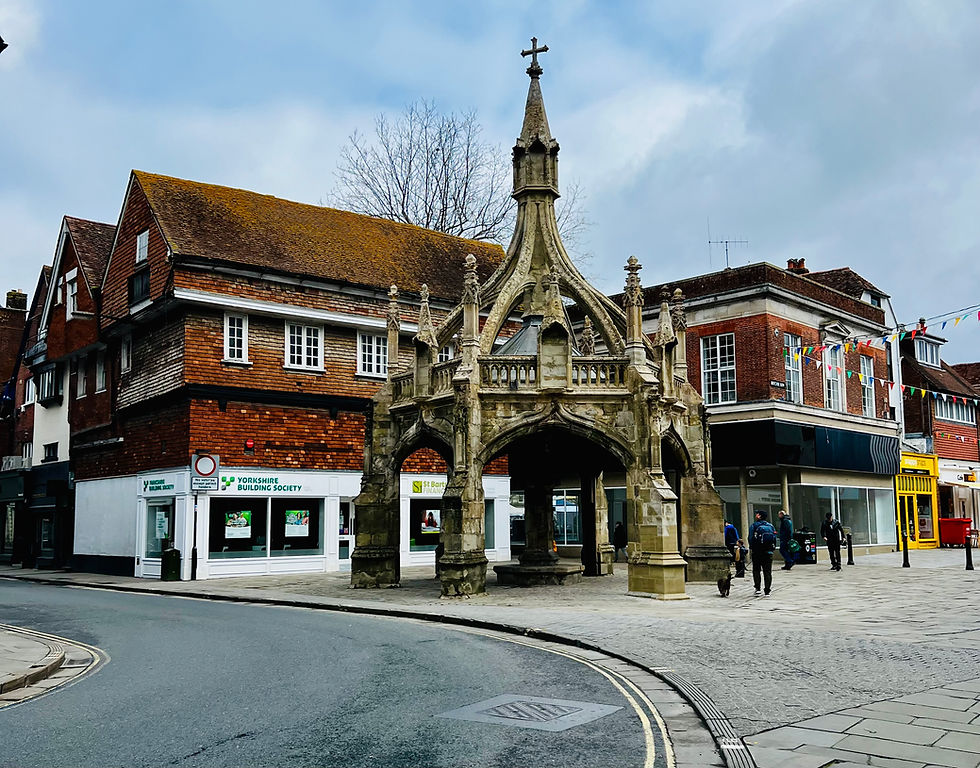

But it was no use having the space if you didn’t have a charter, so the Bishop of Salisbury applied for one. Markets had been held on the site informally, probably around St Thomas’ church since 1219, with the payment to the crown of one palfrey (an expensive riding horse) to the king, but it needed to become official. The king granted the charter for Tuesday markets and also allowed a ten-day fair called the Charter Fair in August. The Tuesday market was a great success, helped by new bridges at Fisherton Street and Harnham. These brought the trade over the rivers Avon and Nadder here at Salisbury and not at the other market locations of Wilton and Old Sarum (what was left of it). Wilton had been the more important town, and they complained bitterly that Salisbury was illegally holding markets and taking trade on other days of the week. At times Wilton’s bailiffs forced traders to sell in Wilton before they got to Salisbury. A compromise was reached and Salisbury got another market day, on Saturdays, but had to toe the line and leave other days for Old Sarum and Wilton. However, the inexorable economic rise of Salisbury soon left them dwindling anyway.
Salisbury’s market also took on a national significance in the commodity of wool and woollen fabric. Sheep grazed on the chalk downs of Salisbury Plain around the City and much of the fabric was made in the city from the fleeces, especially from the later 1300s – hundreds of spinners, dyers, weavers and finishers worked in the houses. Then merchants made fortunes trading it and exporting it and built large expensive houses round the market place, some of which you can see today. Take a tour by Salisbury City Guides to see some of the hidden ones.
The merchants of the city would have all been part of the Merchant Guild. They virtually ran the city and had a council house, the forerunner of todays Guildhall. They had their power curtailed a little though in Salisbury as the Bishop retained much control over trade, tolls and rules here and he had his own Guildhall too. They later amalgamated into the Guildhall we know today. The Guildhall(s) was an important building, where the market and the city were run from and the merchant guild gathered. The church of St Thomas was the merchants’ and many of the townspeoples’ church, rather than the Cathedral. So when celebrating the charter, the two buildings are connected by their place in Salisbury’s trading history and natural to use.


There is one feature of the Market Place we don’t see anymore – the stocks. It was located opposite Bradbeers department store. The law courts, located in the Guildhall, dealt with serious cases, but drunk and disorderly and in particular trading offences were dealt with by ordering some hours in the stocks to be at the mercy of the buying public. Offences could be selling underweight bread, diluted or bad ale (there was an official city ale-taster), forestalling, which was buying up produce on the road to Salisbury before the market or regrating, which was buying produce and then reselling at a higher price.
The market still runs today on Tuesdays and Saturdays and is still an integral part of city life. There a range of stalls from food, to toys, to clothes and vintage finds. And of course large events, socializing, fairs and processions are held in the market place, just as they have been for 800 years. But I don’t think there’s an ale-taster!


Comments